Wednesday, July 2, 2014

Flipkart partners with Karbonn to exclusively sell entry-level Android phones in India

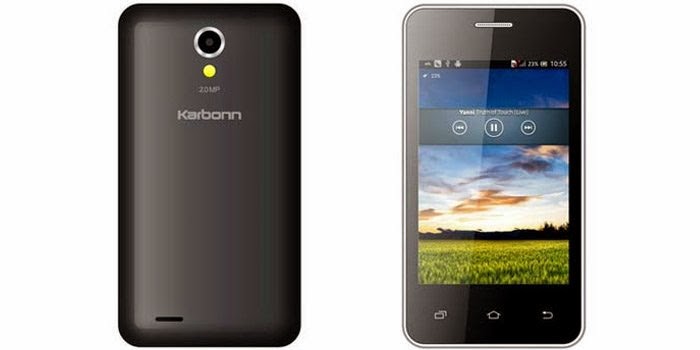
Karbonn has turned to Flipkart to announce four budget Android phones in India dubbed Smart A50S, Smart A52+, Smart A11* and Smart A12* and their prices start at Rs 2699. All four have much in common with regards to their specs sheets and two of them run on the Android KitKat OS.
You’ve heard of the Karbonn Smart A50S smartphone, though it was admittedly pegged higher at Rs 2790 before and now costs just Rs 2699. It’s time to greet its cousin going by the name Smart A52+ which sticks to similar features covering a 3.5-inch touchscreen, a 2MP main camera, dual SIM slots, Android Jelly Bean, 512MB RAM and a dual core MediaTek processor.
But then this 2G-capable Karbonn smartphone veers away on a couple of counts such as its memory which amounts to 4GB (32GB microSD card support) and its larger 1300mAh battery as well as higher Rs 3290 price. Next comes the Smart A11* which is a 3G device getting its steam from Android KitKat 4.4.2.
It works on a 1.2GHz dual core MediaTek chipset, keeping its cost low at Rs 4099, and has a 4-inch display. The handset is powered by 512MB of RAM and offers 4GB onboard storage along with memory expandability. It is kept going by a 1400mAh battery, embeds a 5MP camera on its back and a VGA one above its screen.
Last but not the least is the Karbonn Smart A12* which also happens to get its kicks from KitKat and a dual core MediaTek chip. Its list of features practically matches that of the Smart A11* even though it chooses to go with a larger 4.3-inch touchscreen, the last mentioned of which explains its Rs 4499 price tag.
Also see: Karbonn A50s entry-level smartphone is now available exclusively via Flipkart for Rs 2790
Flipkart doesn’t appear to have hoisted product pages for all four Karbonn smartphones at present seeing as we could only find the older Smart A50S and latest Smart A52+ listed on the website.

A Bright Side to Facebook’s Experiments on Its Users


Facebook’s disclosure last week that it had tinkered with about 700,000 users’ news feeds as part of a psychology experiment conducted in 2012 inadvertently laid bare what too few tech firms acknowledge: that they possess vast powers to closely monitor, test and even shape our behavior, often while we’re in the dark about their capabilities.
The publication of the study, which found that showing people slightly happier messages in their feeds caused them to post happier updates, and sadder messages prompted sadder updates, ignited a torrent of outrage from people who found it creepy that Facebook would play with unsuspecting users’ emotions. Because the study was conducted in partnership with academic researchers, it also appeared to violate long-held rules protecting people from becoming test subjects without providing informed consent. Several European privacy agencies have begun examining whether the study violated local privacy laws.

Tuesday, July 1, 2014

Survey: Americans Can Hardly Function Without Smartphones


MINNEAPOLIS (WCCO) — The number of Americans who use smartphones is at an all-time high.
Also, the number of people who say they can’t live without them is up.
In a new Bank of America survey, nearly half of Americans say they wouldn’t last one day without their phone.
About 91 percent of people surveyed say their mobile device is just as important as their car, or using deodorant.
Most say it’s more important than coffee or television.
“Before I got a smartphone, I didn’t think I needed one of them,” said Fred Crosby, a smartphone user. “Ever since I got it now when I can’t find it, I go into panic mode.”
Experts say as smartphones continue to grow in popularity, people are less likely to dial back on using them.

Samsung Launches Four Budget Android 4.4 KitKat Galaxy Smartphones


 samsung_four_budget_galaxy_smartphones.jpg


Samsung has launched four new affordable Galaxy smartphones - the Galaxy Core II, Galaxy Star 2, Galaxy Ace 4, and Galaxy Young 2. The newly launched Galaxy smartphones are touted to be targeted at the affordable segment. The South Korean consumer electronics giant, as of now, has not revealed any pricing or availability details of the four smartphones.
Notably, all the new Samsung smartphones - the Galaxy Core II, Galaxy Star 2, Galaxy Ace 4, and Galaxy Young 2 - run Android 4.4 KitKat out-of-the-box with the company's TouchWiz Essence UI on top. Further, the Galaxy Core II, Galaxy Star 2, and Galaxy Young 2 are dual-SIM devices, while the Galaxy Ace 4 is a single SIM device and has been launched in 3G and LTE variants, according to Samsung Tomorrow.
The Samsung Galaxy Core II comes with a 4.5-inch WVGA (480x800 pixels) TFT display and is powered by a quad-core processor clocked at 1.2GHz. Other specifications include a 5-megapixel autofocus rear camera with LED flash; VGA front-facing camera; 768MB of RAM; 4GB of inbuilt storage; 64GB expandable storage support (via microSD card), and 2000mAh battery. Connectivity options on the smartphone include Wi-Fi b/g/n, Bluetooth 4.0, Micro-USB and 3G. The Galaxy Core II will be available in Black and White colour variants. It comes with dimensions 130.3x68x9.8mm and weighs 138 grams. It is the successor to the Galaxy Core launched in June last year.
The Samsung Galaxy Ace 4, as mentioned earlier, comes in two variants - LTE and 3G. Both the variants of the Galaxy Ace 4 come with slightly different set of specifications.
The Galaxy Ace 4 LTE comes with dimensions 121.4x62.9x11mm and weighs 130.3 grams, while the Galaxy Ace 4 (3G) comes with 121.4x62.9x10.8mm dimensions and weighs 123.8 grams. The LTE variant packs 1GB of RAM, while the 3G variant comes with 512MB of RAM. The Galaxy Ace 4 LTE is powered by a 1.2GHz dual-core processor and packs an 1800mAh battery. Meanwhile, the Galaxy Ace 4 (3G) is backed by a 1GHz dual-core processor and packs 1500mAh battery. Common specifications of the Galaxy Ace 4 3G and LTE variants are 4-inch WVGA TFT display, 5-megapixel rear camera, and VGA front camera.
The smartphone comes with Bluetooth 4.0, Wi-Fi b/g/n, A-GPS, GLONASS, and Micro-USB connectivity options. Both the variants of the Galaxy Ace 4 will be available in Iris Charcoal and Classic White colours.
The Samsung Galaxy Young 2 features a 3.5-inch HVGA (320x480 pixels) TFT display and is backed by a 1GHz single-core processor clubbed with 512MB of RAM. There is a 3-megapixel fixed-focus rear camera. It comes with 4GB inbuilt storage which is further expandable up to 32GB via microSD card.
Connectivity options include Bluetooth 4.0, Wi-Fi b/g/n, A-GPS, GLONASS, 3G and Micro-USB. It measures 109.8x59.9x11.8mm and weighs 108 grams. The Galaxy Young 2 packs a 1300mAh battery and comes in two colour variants - Iris Charcoal and White.
Lastly, the Samsung Galaxy Star 2 comes with a 3.5-inch HVGA (320x480 pixels). It is powered by a single-core Spreadtrum SC6815A clocked at 1GHz alongside 512MB of RAM.
The smartphone sports a 2-megapixel fixed focus rear camera and includes 4GB of inbuilt storage which is further expandable up to 32GB via microSD card. It includes Bluetooth 4.0, Wi-Fi b/g/n, and Micro-USB connectivity options. The Galaxy Star 2 does not come with 3G network support and comes with identical dimensions as the Galaxy Young 2. It packs a 1300mAh battery
In addition, the Galaxy Star 2 and Galaxy Young 2 come with eight downloadable Gameloft games for users.

With self-driving cars, the gap between Silicon Valley and Detroit is vast


 Google car

If and when Google Inc. decides to mass produce a self-driving car, the company will need a partner in the automotive industry to build them. It's either that, or try to enter an industry that requires billions in overhead and liability protection – as well as experience.
But according to a recent report by Reuters, the gap between Google's idea for the future of the industry and automakers' long experience is vast. Google's prototypes represent big, big changes in the industry and the way people use cars, a mindset that is at odds with the conventional industry's expectations.
Google's funky-looking vehicles don't have steering wheels, accelerators or brake pedals. Their top speed is 25 miles per hour. Perhaps even more frightening for automakers, Google co-founder Sergey Brin has said that he envisions the cars being used as an on-demand service rather than Henry Ford's age-old everyone-gets-a-car ownership model.
Moreover, carmakers have been developing their own autonomous car technology. They favor a more reserved approach to integrating the technology, going for incremental features like self-parking. The biggest leap of faith for carmakers in jumping to such a radically different driving paradigm involves liability, Reuters said.
If a self-driving car crashes, it's not clear who's liable. And while Google has reportedly said it would take responsibility for such accidents, companies like General Motors (whose stock is bafflingly up today after announcing it recalled another 8.4 million cars) are hesitant to take on any extra risk.
In any case, it appears that the carmakers need Google as much as it needs them.
"Google is the 800-pound gorilla in the room and nobody wants to miss the boat," Edwin Olson, assistant professor of computer science at the University of Michigan, who works with Ford on an automated vehicle project, told Reuters. "But at the same time I don’t think automakers want Google to be dictating terms if the time comes and Google is the only game in town."

Databricks Raises $33 Million and Introduces Cloud Platform for Processing Big Data

TechCrunch reports that Databricks has raised $33 Million in its Series B Round of Funding. The funding round was led by New Enterprise Associates with participation from previous investor Andreessen Horowitz. Databricks is the commercial entity created by the developers of the open source Apache Spark project. Big data is a big deal and companies want to help customers process the data, so Databricks hopes to simplify the whole matter by transferring it to the cloud to decrease management pains, while speeding it up by utilizing Apache Spark to drive the platform. In addition to the funding, the company also announced a new cloud platform known as Databricks Cloud, which has been designed to simplify big data processing by bringing the process under one cloud umbrella
Databricks, the commercial entity created by the developers of the open source Apache Spark project, announced $33M in Series B funding today and the launch of a new cloud product, their first one as a company.
There is little doubt that big data is a big deal these days and companies are popping up to help customers process the data. Databricks hopes to simplify the entire matter by moving it to the cloud to reduce management headaches, while speeding it up by using Apache Spark to drive the platform.
First, let’s look at the funding, which is led by New Enterprise Associates (NEA)  with a contribution from previous investor Andreessen Horowitz.  It brings the total funding to date to $47M.
The latest round gives the company a huge financial boost and CEO Ian Stoica says, they hope to increase the number of employees and expand rapidly.
In addition to the funding, the company also announced a new cloud platform called Databricks Cloud that Stoica, says has been designed to simplify big data processing by bringing the process under one cloud umbrella.
The cloud solution consists of three pieces: The Databricks Platform, Spark and the Databricks workspace. The idea behind the product, Stoica says, is to provide a single place to process data without having to worry about managing a Hadoop cluster to process your data. It’s all done in the cloud instead in a managed environment.
After you add your data to a project, you can begin working with it immediately. The product has several core concepts starting with Notebooks, which provide a way to interact with the data and build graphs. As you discover ways of displaying your data, you can begin to build dashboards to monitor certain types of data. Finally, the platform includes a job launcher, which enables users to schedule Apache Spark jobs to run at certain times.
The product has been designed to allow customers to access and plug in third-party Spark applications, so if they have additional requirements not available in the base Databricks platform, they can use existing third-party applications to take advantage of whatever those tools have to offer.
The company believes that by providing a set of tools built in the cloud, they will remove much of the pain and complexity involved with a typical big data processing project where so much time is spent simply getting the right tool set in place before any work even gets done.
Initially, Stoica told TechCrunch, the product will run on AWS, but they are looking to expand to Google Compute Engine and Microsoft Azure –and their large infusion of cash should help facilitate that.
The company was born out of the Apache Spark project, which was originally developed by Stoica and colleagues from research at The University of California, Berkeley in 2009. He and his fellow researchers were looking for something that was faster than Hadoop and they developed Spark, which they open sourced in 2010.
Stoica says that it’s faster for a number of reasons including that it requires less code to process the job and it runs entirely in-memory, rather than using disk reads, which can slow down the processing.
While the company continues to support the open source project, last year as Spark was gaining traction, they decided to create a commercial entity on top of that and got $13.7M from Andreessen Horowitz to build the product and the company.
Today marks their debut product. Stoica indicated the platform is available to a limited set of customers today, but they will be expanding that gradually in the coming months.

U.S. Accuses T-Mobile Of Overbilling


WASHINGTON — T-Mobile, which sees itself as a new kind of carrier, now stands accused of an old-fashioned practice — overbilling its customers.
The Federal Trade Commission on Tuesday brought a legal action accusing T-Mobile of illegally earning hundreds of millions of dollars by placing bogus charges on customers’ cellphone bills for premium texting services that the consumers never ordered. Regulators said that T-Mobile had been allowing the third-party charges, and taking a hefty cut of the revenue, since 2009.
The case is one of the largest yet brought by regulators against a major telecommunications company for unauthorized billing, known as “cramming.” The practice has been relatively common for landlines, but recently began to appear on mobile bills.
In T-Mobile’s case, the F.T.C. said, fees for services like “flirting tips, horoscope information or celebrity gossip,” typically were for $9.99, of which 35 to 40 percent went to T-Mobile. In some cases, customers were charged for “years after becoming aware of signs that the charges were fraudulent,” it said.
Jessica Rich, director of the agency’s Bureau of Consumer Protection, said in a briefing that T-Mobile had “ignored telltale signs of fraud” in the charges, harming many consumers.
John Legere, T-Mobile’s chief executive, said in a statement that the F.T.C.’s accusations were without merit.
Also on Tuesday, the Federal Communications Commission said it was investigating T-Mobile’s billing practices after receiving consumer complaints. The commission and the F.T.C. are the two main regulators of the telecommunications industry.
The inquiry and the accusations come at an awkward time for T-Mobile, which has been reported to be in talks with Sprint for a merger that would have to be approved by the F.C.C. T-Mobile has trumpeted itself in its ad campaign as the “Un-carrier” eliminating the things that frustrate customers, like hidden charges and confusing two-year contracts. For its efforts, the company has won praise and millions of customers.
Some of the charges resulted in refunds being given to 40 percent of the customers who asked for them, “an obvious sign to T-Mobile that the charges were never authorized by its customers,” the F.T.C. said.
“It’s wrong for a company like T-Mobile to profit from scams against its customers when there were clear warning signs the charges it was imposing were fraudulent,” said Edith Ramirez, the F.T.C. chairwoman. “The FTC’s goal is to ensure that T-Mobile repays all its customers for these crammed charges.”
In his statement, Mr. Legere said that last year the company stopped allowing third-party companies to impose charges, and last month proactively offered refunds to customers.
“We are disappointed that the F.T.C. has chosen to file this action against the most pro-consumer company in the industry rather than the real bad actors,” Mr. Legere said. “The F.T.C.’s lawsuit seeking to hold T-Mobile responsible for their acts is not only factually and legally unfounded, but also misdirected.”
According to the F.T.C. complaint, filed in federal court in Seattle, T-Mobile told the agency that consumers had authorized the charges. But the agency said the company had shown “no proof of consumers’ doing so.” Commission officials said they had tried unsuccessfully to reach a settlement with T-Mobile.
The F.T.C. is seeking refunds for consumers, and to permanently prevent T-Mobile from engaging in cramming. The commission lacks the power to impose its own fines for charges of consumer fraud, but the F.C.C. has that authority. In the last four years that agency has taken nine enforcement actions against companies for cramming that have totaled more than $33 million in proposed fines.
Consumers would have had a hard time figuring out that they were being charged by T-Mobile for the services, the F.T.C. said, because the company’s online billing statements did not show that the charge was coming from a third party or that it was a recurring payment. Its full-length bills, which often run to dozens of pages, gave more information, but in what was often unintelligible fashion, the agency said.
For example, one type of unauthorized charges appeared on bills with the service listed as “8888906150BmStorm23918,” the F.T.C. said. Consumers who had prepaid phone plans do not receive a bill at all; therefore, the amount was simply deducted from their accounts, according to the agency.
T-Mobile announced in November 2013 that it would no longer allow third parties to bill its customers for premium texting services. When it offered refunds last month to consumers, Mike Sievert, the company’s chief marketing officer, said: “If customers were charged for services they didn’t want, we’ll make it right. That’s being the Un-carrier.”
The F.T.C.’s complaint says, however, that T-Mobile knew in early 2012 that customers were complaining about the charges in increasing numbers and that it had identified several third-party merchants as the subject of those complaints. But, the F.T.C. said, T-Mobile did little to determine whether the customers had authorized the charges.
T-Mobile refused to give some consumers refunds when they asked for them, the commission said, or told them it would block future charges and then failed to do so.

Kindle Fire Case