Moment’ app CUREs your iPhone addiction. This is going to measure and cure your digital addiction.
If you can’t stay away from your iPhone even if you try, then this
new app is for you. The new iOS app, Moment, claims that it can keep
people away from their iPhone by allowing then to use it less.
The app lets you limit your iPhone uses and will allow you to spend
more time doing some other stuff than hanging around with your
smartphone.
Moment continuously runs in the background of the iPhone and keeps
tracking your daily usage and lets you know the amount of time you spent
on your iPhone. It also allows you to set a usage limit and notifies
you when you reach the limit. Users can also set their phone to
instantly switch off if they cross their limit set in the app,
compelling them to keep their iPhone away and enjoy their life.
“I built Moment to help nudge me in the right direction by
automatically tracking my daily iPhone use and giving me a warning when
I’m on it for too long,” app designer Kevin Holesh stated on his blog
post.
“My goal was to find a balance of connected and disconnected that was
right for me. Moment has helped me gain another 35 minutes every day to
take my dogs for a hike or do a quick workout instead of mindlessly
scrolling through Twitter,” he said. “Moment is helping me find that
balance,” Holesh added.
A brand new Videocon VPhone Grande has emerged in India with a price
of Rs 1950 attached to it and you’re undoubtedly wondering whether it
works on Android or not considering its tag. Manufacturers these days
are surprising us with so many low cost handsets running the Google
mobile OS, feature phones make their debut few and far between.
Videocon is clearly still trying to break big into the scene that Nokia
is most popular in even after its sale to Microsoft. The VPhone Grande
has all the specifications a first time phone buyer or backup device
seeker could ask of a gadget of its ilk starting from the basics such as
FM radio and recording as well as Bluetooth connectivity.
In keeping with the trend of low cost handsets allowing you to juggle with mobile numbers, this Videocon phone hides dual SIM slots under its hood. It has a modest 2.8-inch color display on the front and a 1.3MP camera with flash on the back. Though the internal memory hasn’t been mentioned, you can slide in a microSD card of up to 32GB. Also see:Celkon unveils Campus A35K Android 4.4 KitKat phone on Snapdeal for Rs 2999 Videocon VPhone Grande: Quick look at its key specs
- 2.8-inch QVGA resolution screen - 1.3MP camera - GRPS and Bluetooth connectivity - 32GB microSD support - 1100mAh Li-ion battery - Dual SIM dual standby - FM radio with recording - LED flash light - 68 grams - Black, white, blue colors
The Videocon VPhone Grande can be purchased from three online retailers at present and these include HomeShop18, Digiworld and Next.
Karbonn has turned to Flipkart
to announce four budget Android phones in India dubbed Smart A50S,
Smart A52+, Smart A11* and Smart A12* and their prices start at Rs 2699.
All four have much in common with regards to their specs sheets and two
of them run on the Android KitKat OS.
You’ve
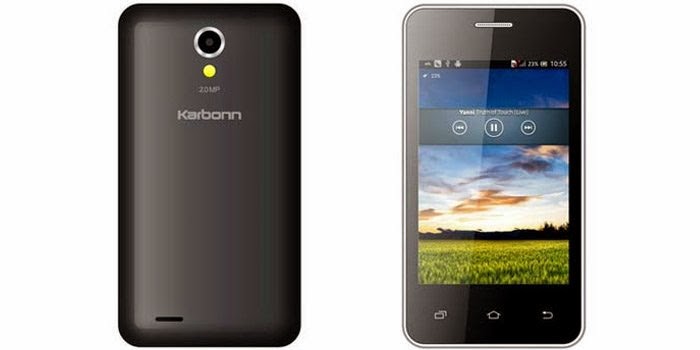
heard of the Karbonn Smart A50S smartphone, though it was admittedly
pegged higher at Rs 2790 before and now costs just Rs 2699. It’s time to
greet its cousin going by the name Smart A52+ which sticks to similar
features covering a 3.5-inch touchscreen, a 2MP main camera, dual SIM
slots, Android Jelly Bean, 512MB RAM and a dual core MediaTek processor.
But then this 2G-capable Karbonn smartphone
veers away on a couple of counts such as its memory which amounts to
4GB (32GB microSD card support) and its larger 1300mAh battery as well
as higher Rs 3290 price. Next comes the Smart A11* which is a 3G device getting its steam from Android KitKat 4.4.2.
It
works on a 1.2GHz dual core MediaTek chipset, keeping its cost low at
Rs 4099, and has a 4-inch display. The handset is powered by 512MB of
RAM and offers 4GB onboard storage along with memory expandability. It
is kept going by a 1400mAh battery, embeds a 5MP camera on its back and a VGA one above its screen.
Last but not the least is the Karbonn Smart A12* which also happens to get its kicks from KitKat
and a dual core MediaTek chip. Its list of features practically matches
that of the Smart A11* even though it chooses to go with a larger
4.3-inch touchscreen, the last mentioned of which explains its Rs 4499
price tag. Also see:Karbonn A50s entry-level smartphone is now available exclusively via Flipkart for Rs 2790
Flipkart
doesn’t appear to have hoisted product pages for all four Karbonn
smartphones at present seeing as we could only find the older Smart A50S
and latest Smart A52+ listed on the website.
Facebook’s
disclosure last week that it had tinkered with about 700,000 users’
news feeds as part of a psychology experiment conducted in 2012
inadvertently laid bare what too few tech firms acknowledge: that they
possess vast powers to closely monitor, test and even shape our
behavior, often while we’re in the dark about their capabilities.
The publication of the study,
which found that showing people slightly happier messages in their
feeds caused them to post happier updates, and sadder messages prompted
sadder updates, ignited a torrent of outrage from people who found it
creepy that Facebook would play with unsuspecting users’ emotions.
Because the study was conducted in partnership with academic
researchers, it also appeared to violate long-held rules protecting
people from becoming test subjects without providing informed consent.
Several European privacy agencies have begun examining whether the study violated local privacy laws.
MINNEAPOLIS (WCCO) — The number of Americans who use smartphones is at an all-time high.
Also, the number of people who say they can’t live without them is up.
In a new Bank of America survey, nearly half of Americans say they wouldn’t last one day without their phone.
About 91 percent of people surveyed say their mobile device is just as important as their car, or using deodorant.
Most say it’s more important than coffee or television.
“Before
I got a smartphone, I didn’t think I needed one of them,” said Fred
Crosby, a smartphone user. “Ever since I got it now when I can’t find
it, I go into panic mode.”
Experts say as smartphones continue to grow in popularity, people are less likely to dial back on using them.
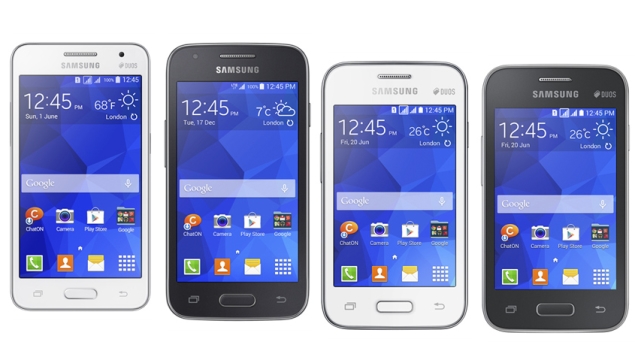
Samsung has launched four new affordable Galaxy smartphones - the Galaxy
Core II, Galaxy Star 2, Galaxy Ace 4, and Galaxy Young 2. The newly
launched Galaxy smartphones are touted to be targeted at the affordable
segment. The South Korean consumer electronics giant, as of now, has not
revealed any pricing or availability details of the four smartphones.
Notably,
all the new Samsung smartphones -
the Galaxy Core II, Galaxy Star 2, Galaxy Ace 4, and Galaxy Young 2 -
run Android 4.4 KitKat out-of-the-box with the company's TouchWiz
Essence UI on top. Further, the Galaxy Core II, Galaxy Star 2, and
Galaxy Young 2 are dual-SIM devices, while the Galaxy Ace 4 is a single
SIM device and has been launched in 3G and LTE variants, according to
Samsung Tomorrow.
The
Samsung Galaxy Core II comes with a 4.5-inch WVGA (480x800 pixels) TFT
display and is powered by a quad-core processor clocked at 1.2GHz. Other
specifications include a 5-megapixel autofocus rear camera with LED
flash; VGA front-facing camera; 768MB of RAM; 4GB of inbuilt storage;
64GB expandable storage support (via microSD card), and 2000mAh battery.
Connectivity options on the smartphone include Wi-Fi b/g/n, Bluetooth
4.0, Micro-USB and 3G. The Galaxy Core II will be available in Black and
White colour variants. It comes with dimensions 130.3x68x9.8mm and
weighs 138 grams. It is the successor to the Galaxy Core launched in
June last year.
The Samsung Galaxy Ace 4, as mentioned earlier,
comes in two variants - LTE and 3G. Both the variants of the Galaxy Ace 4
come with slightly different set of specifications.
The Galaxy
Ace 4 LTE comes with dimensions 121.4x62.9x11mm and weighs 130.3 grams,
while the Galaxy Ace 4 (3G) comes with 121.4x62.9x10.8mm dimensions and
weighs 123.8 grams. The LTE variant packs 1GB of RAM, while the 3G
variant comes with 512MB of RAM. The Galaxy Ace 4 LTE is powered by a
1.2GHz dual-core processor and packs an 1800mAh battery. Meanwhile, the
Galaxy Ace 4 (3G) is backed by a 1GHz dual-core processor and packs
1500mAh battery. Common specifications of the Galaxy Ace 4 3G and LTE
variants are 4-inch WVGA TFT display, 5-megapixel rear camera, and VGA
front camera.
The smartphone comes with Bluetooth 4.0, Wi-Fi
b/g/n, A-GPS, GLONASS, and Micro-USB connectivity options. Both the
variants of the Galaxy Ace 4 will be available in Iris Charcoal and
Classic White colours.
The Samsung Galaxy Young 2 features a
3.5-inch HVGA (320x480 pixels) TFT display and is backed by a 1GHz
single-core processor clubbed with 512MB of RAM. There is a 3-megapixel
fixed-focus rear camera. It comes with 4GB inbuilt storage which is
further expandable up to 32GB via microSD card.
Connectivity
options include Bluetooth 4.0, Wi-Fi b/g/n, A-GPS, GLONASS, 3G and
Micro-USB. It measures 109.8x59.9x11.8mm and weighs 108 grams. The
Galaxy Young 2 packs a 1300mAh battery and comes in two colour variants -
Iris Charcoal and White.
Lastly, the Samsung Galaxy Star 2 comes
with a 3.5-inch HVGA (320x480 pixels). It is powered by a single-core
Spreadtrum SC6815A clocked at 1GHz alongside 512MB of RAM.
The
smartphone sports a 2-megapixel fixed focus rear camera and includes 4GB
of inbuilt storage which is further expandable up to 32GB via microSD
card. It includes Bluetooth 4.0, Wi-Fi b/g/n, and Micro-USB connectivity
options. The Galaxy Star 2 does not come with 3G network support and
comes with identical dimensions as the Galaxy Young 2. It packs a
1300mAh battery
In addition, the Galaxy Star 2 and Galaxy Young 2 come with eight downloadable Gameloft games for users.
If and when Google
Inc. decides to mass produce a self-driving car, the company will need a
partner in the automotive industry to build them. It's either that, or
try to enter an industry that requires billions in overhead and
liability protection – as well as experience.
But according to a recent report by Reuters,
the gap between Google's idea for the future of the industry and
automakers' long experience is vast. Google's prototypes represent big,
big changes in the industry and the way people use cars, a mindset that
is at odds with the conventional industry's expectations.
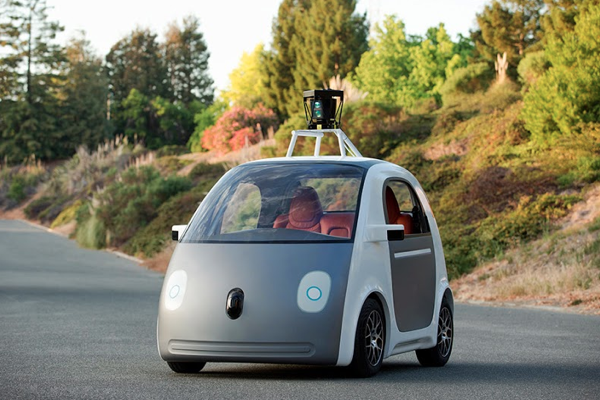
Google's funky-looking vehicles don't have steering wheels,
accelerators or brake pedals. Their top speed is 25 miles per hour.
Perhaps even more frightening for automakers, Google co-founder Sergey
Brin has said that he envisions the cars being used as an on-demand
service rather than Henry Ford's age-old everyone-gets-a-car ownership
model.
Moreover, carmakers have been developing their own autonomous car
technology. They favor a more reserved approach to integrating the
technology, going for incremental features like self-parking. The
biggest leap of faith for carmakers in jumping to such a radically
different driving paradigm involves liability, Reuters said.
If a self-driving car crashes, it's not clear who's liable. And while
Google has reportedly said it would take responsibility for such
accidents, companies like General Motors
(whose stock is bafflingly up today after announcing it recalled
another 8.4 million cars) are hesitant to take on any extra risk.
In any case, it appears that the carmakers need Google as much as it needs them.
"Google is the 800-pound gorilla in the room and nobody wants to miss
the boat," Edwin Olson, assistant professor of computer science at the
University of Michigan, who works with Ford on an automated vehicle
project, told Reuters. "But at the same time I don’t think automakers
want Google to be dictating terms if the time comes and Google is the
only game in town."
 Moment continuously runs in the background of the iPhone and keeps
tracking your daily usage and lets you know the amount of time you spent
on your iPhone. It also allows you to set a usage limit and notifies
you when you reach the limit. Users can also set their phone to
instantly switch off if they cross their limit set in the app,
compelling them to keep their iPhone away and enjoy their life.
Moment continuously runs in the background of the iPhone and keeps
tracking your daily usage and lets you know the amount of time you spent
on your iPhone. It also allows you to set a usage limit and notifies
you when you reach the limit. Users can also set their phone to
instantly switch off if they cross their limit set in the app,
compelling them to keep their iPhone away and enjoy their life.